

Zoning Standards for Small Area Plans
What is the goal of this project?
The City has adopted four of the five small area plans recommended in the Comprehensive Plan. One of the primary ways the small area plans are used is to provide guidance when considering development applications within the activity centers. This includes design elements such as building height, vehicular and pedestrian connections, open space, and building orientation. Some of the guidance in the small area plans conflicts with code requirements in our Zoning Ordinance. In addition, the current Zoning Ordinance can't be used to enforce some of the location based guidance in the plans such as where new streets and open spaces should go. Instead, these elements have to be negotiated with developers and provided through proffers or commitments. The goal of this project is to provide recommendations to amend the Zoning Ordinance to better align the requirements of the Zoning Ordinance with the guidance from the small area plans.
Where are we in the process?
There are three phases for this project and we are currently in the and final third phase. The first phase included background research, preliminary analysis, and community input. In the second phase, the project team developed preferred strategies and final recommendations. The project is now in phase three. During this phase the consultant team is preparing a draft.
Summary of Proposed Amendments: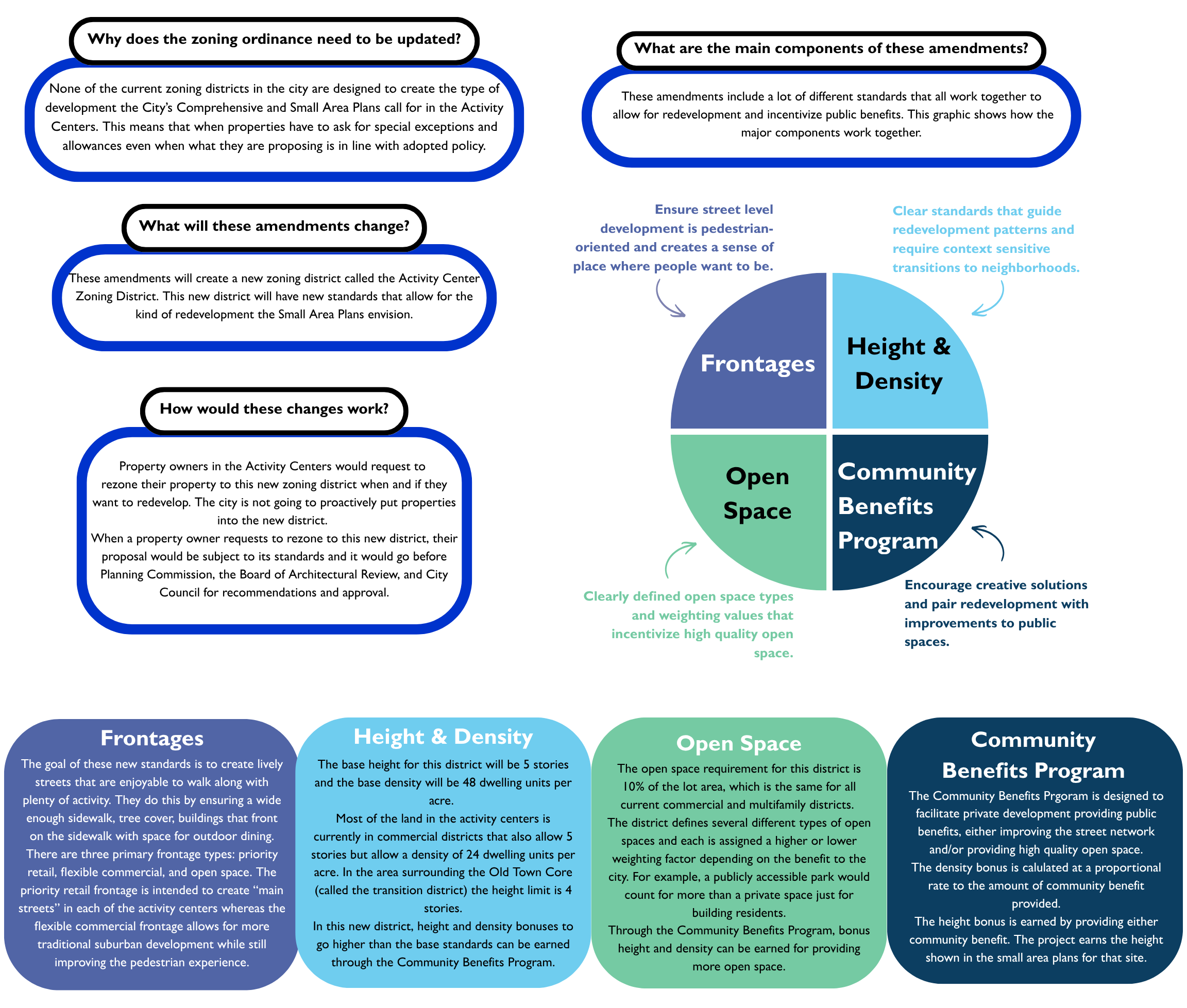
You can view the current draft here or under the project documents tab on the right.
What is the goal of this project?
The City has adopted four of the five small area plans recommended in the Comprehensive Plan. One of the primary ways the small area plans are used is to provide guidance when considering development applications within the activity centers. This includes design elements such as building height, vehicular and pedestrian connections, open space, and building orientation. Some of the guidance in the small area plans conflicts with code requirements in our Zoning Ordinance. In addition, the current Zoning Ordinance can't be used to enforce some of the location based guidance in the plans such as where new streets and open spaces should go. Instead, these elements have to be negotiated with developers and provided through proffers or commitments. The goal of this project is to provide recommendations to amend the Zoning Ordinance to better align the requirements of the Zoning Ordinance with the guidance from the small area plans.
Where are we in the process?
There are three phases for this project and we are currently in the and final third phase. The first phase included background research, preliminary analysis, and community input. In the second phase, the project team developed preferred strategies and final recommendations. The project is now in phase three. During this phase the consultant team is preparing a draft.
Summary of Proposed Amendments:
You can view the current draft here or under the project documents tab on the right.
Questions
Ask the project team a question.
-
Share How are we encouraging native plants and biodiversity while reducing the impact of invasive species, i.e. lanternflies and the Tree of heaven? on Facebook Share How are we encouraging native plants and biodiversity while reducing the impact of invasive species, i.e. lanternflies and the Tree of heaven? on X (formerly Twitter) Share How are we encouraging native plants and biodiversity while reducing the impact of invasive species, i.e. lanternflies and the Tree of heaven? on Linkedin Email How are we encouraging native plants and biodiversity while reducing the impact of invasive species, i.e. lanternflies and the Tree of heaven? link
How are we encouraging native plants and biodiversity while reducing the impact of invasive species, i.e. lanternflies and the Tree of heaven?
Local Wildlife asked about 1 month agoThere is a provision in the proposed amendments for management and removal of invasive species. Plantings are reviewed with every development proposal to encourage the use of native species.
-
Share Shouldn't the Zoning Ordinance contain a provision saying something like this, to bring our rules into the modern era: "All new apartment buildings in the City will have off-street parking spaces, lanes or bays for up to four vehicles within 100 feet of their entrances to allow parcel and food delivery vehicles, small after-school activity buses, personnel pick and delivery vehicles, and property move-in vehicles, to have a safe place to pull-in off street for short periods to conduct their business without interfering with routine traffic on City streets. on Facebook Share Shouldn't the Zoning Ordinance contain a provision saying something like this, to bring our rules into the modern era: "All new apartment buildings in the City will have off-street parking spaces, lanes or bays for up to four vehicles within 100 feet of their entrances to allow parcel and food delivery vehicles, small after-school activity buses, personnel pick and delivery vehicles, and property move-in vehicles, to have a safe place to pull-in off street for short periods to conduct their business without interfering with routine traffic on City streets. on X (formerly Twitter) Share Shouldn't the Zoning Ordinance contain a provision saying something like this, to bring our rules into the modern era: "All new apartment buildings in the City will have off-street parking spaces, lanes or bays for up to four vehicles within 100 feet of their entrances to allow parcel and food delivery vehicles, small after-school activity buses, personnel pick and delivery vehicles, and property move-in vehicles, to have a safe place to pull-in off street for short periods to conduct their business without interfering with routine traffic on City streets. on Linkedin Email Shouldn't the Zoning Ordinance contain a provision saying something like this, to bring our rules into the modern era: "All new apartment buildings in the City will have off-street parking spaces, lanes or bays for up to four vehicles within 100 feet of their entrances to allow parcel and food delivery vehicles, small after-school activity buses, personnel pick and delivery vehicles, and property move-in vehicles, to have a safe place to pull-in off street for short periods to conduct their business without interfering with routine traffic on City streets. link
Shouldn't the Zoning Ordinance contain a provision saying something like this, to bring our rules into the modern era: "All new apartment buildings in the City will have off-street parking spaces, lanes or bays for up to four vehicles within 100 feet of their entrances to allow parcel and food delivery vehicles, small after-school activity buses, personnel pick and delivery vehicles, and property move-in vehicles, to have a safe place to pull-in off street for short periods to conduct their business without interfering with routine traffic on City streets.
Names101 asked about 1 month agoThis is an issue better addressed on a citywide basis. The zoning ordinance has standards for the required number of off-street parking spaces, parking locations, and loading areas.
-
Share Is the Draft complete? Maybe I'm missing something, but it looks like several Tables and Figures mentioned in the draft, in the discussion starting on Page 62, are missing. These are the ones that would say what a developer must do to earn "bonus" credits to be used to increase the height of buildings in the SAP areas. Question: What are the things that will earn credits for the Applicants to build bonus stories of buildings in the SAP areas? Question: Who will judge (during the approval process) that what the Applicant is offering is adequate, or performed to the standard? Question: What are the provisions for the public (e.g., the people who live here) to get involved in the bonus process? Question: Is City Council giving up its responsibility of deciding the height of buildings in the City, or delegating it to an appointed official on City Staff? This bonus program recognizes that height and/or density are incentives for the developer – they lead to greater profits on a set area of land. But what do they do for the City or its residents? on Facebook Share Is the Draft complete? Maybe I'm missing something, but it looks like several Tables and Figures mentioned in the draft, in the discussion starting on Page 62, are missing. These are the ones that would say what a developer must do to earn "bonus" credits to be used to increase the height of buildings in the SAP areas. Question: What are the things that will earn credits for the Applicants to build bonus stories of buildings in the SAP areas? Question: Who will judge (during the approval process) that what the Applicant is offering is adequate, or performed to the standard? Question: What are the provisions for the public (e.g., the people who live here) to get involved in the bonus process? Question: Is City Council giving up its responsibility of deciding the height of buildings in the City, or delegating it to an appointed official on City Staff? This bonus program recognizes that height and/or density are incentives for the developer – they lead to greater profits on a set area of land. But what do they do for the City or its residents? on X (formerly Twitter) Share Is the Draft complete? Maybe I'm missing something, but it looks like several Tables and Figures mentioned in the draft, in the discussion starting on Page 62, are missing. These are the ones that would say what a developer must do to earn "bonus" credits to be used to increase the height of buildings in the SAP areas. Question: What are the things that will earn credits for the Applicants to build bonus stories of buildings in the SAP areas? Question: Who will judge (during the approval process) that what the Applicant is offering is adequate, or performed to the standard? Question: What are the provisions for the public (e.g., the people who live here) to get involved in the bonus process? Question: Is City Council giving up its responsibility of deciding the height of buildings in the City, or delegating it to an appointed official on City Staff? This bonus program recognizes that height and/or density are incentives for the developer – they lead to greater profits on a set area of land. But what do they do for the City or its residents? on Linkedin Email Is the Draft complete? Maybe I'm missing something, but it looks like several Tables and Figures mentioned in the draft, in the discussion starting on Page 62, are missing. These are the ones that would say what a developer must do to earn "bonus" credits to be used to increase the height of buildings in the SAP areas. Question: What are the things that will earn credits for the Applicants to build bonus stories of buildings in the SAP areas? Question: Who will judge (during the approval process) that what the Applicant is offering is adequate, or performed to the standard? Question: What are the provisions for the public (e.g., the people who live here) to get involved in the bonus process? Question: Is City Council giving up its responsibility of deciding the height of buildings in the City, or delegating it to an appointed official on City Staff? This bonus program recognizes that height and/or density are incentives for the developer – they lead to greater profits on a set area of land. But what do they do for the City or its residents? link
Is the Draft complete? Maybe I'm missing something, but it looks like several Tables and Figures mentioned in the draft, in the discussion starting on Page 62, are missing. These are the ones that would say what a developer must do to earn "bonus" credits to be used to increase the height of buildings in the SAP areas. Question: What are the things that will earn credits for the Applicants to build bonus stories of buildings in the SAP areas? Question: Who will judge (during the approval process) that what the Applicant is offering is adequate, or performed to the standard? Question: What are the provisions for the public (e.g., the people who live here) to get involved in the bonus process? Question: Is City Council giving up its responsibility of deciding the height of buildings in the City, or delegating it to an appointed official on City Staff? This bonus program recognizes that height and/or density are incentives for the developer – they lead to greater profits on a set area of land. But what do they do for the City or its residents?
Names101 asked about 1 month agoQuestion: Is the draft complete? Maybe I'm missing something, but it looks like several Tables and Figures mentioned in the draft, in the discussion starting on Page 62, are missing. These are the ones that would say what a developer must do to earn "bonus" credits to be used to increase the height of buildings in the SAP areas.
Answer: All of the referenced tables and figures are included in this draft. The bonus credits table that qualifies the discussion on Page 62 is on Page 65, Table 6: Baseline Bonus Requirement. Figure 7 on page 68 shows the potential height bonuses that can be earned by participating in the Community Benefits Program. (These page references are for the markup version of the draft. For better ease of reading, view the Public Review Draft Revised June 2026).
Question: What are the things that will earn credits for the Applicants to build bonus stories of buildings in the SAP areas?
Answer: There are two community benefits that qualify for development bonuses: Open Space and Multimodal Infrastructure. These are described on page 62 and detail on eligibility are on pages 63 and 64. The density bonus calculation is shown in Table 6 on page 65. The potential bonus height limits that can be earned are shown in Figure 7 on page 68). (These page references are for the markup version of the draft. For better ease of reading, view the Public Review Draft Revised June 2026).
Question: Who will judge (during the approval process) that what the Applicant is offering is adequate, or performed to the standard?
Answer: The qualifications and eligibility requirements for the community benefits applicants provide are described on pages 63 and 64.
Question: What are the provisions for the public (e.g., the people who live here) to get involved in the bonus process?
Answer: Any application using this district would be a rezoning which would go through public hearings with the Board of Architectural Review, Planning Commission, and City Council. The public can comment at these public hearings as well as sharing comments with City Council and boards and commissions throughout the entirety of the review process.
Question: Is City Council giving up its responsibility of deciding the height of buildings in the City, or delegating it to an appointed official on City Staff? This bonus program recognizes that height and/or density are incentives for the developer - they lead to greater profits on a set area of land. But what do they do for the City or its residents?
Answer: No, City Council is still the final authority. Applicants using this district would be requesting a rezoning which means that they would have to go before the Board of Architectural Review, Planning Commission, and City Council. The Board of Architectural Review and Planning Commission provide recommendations to City Council, who then makes the final decision of approval or denial.
The purpose of the Community Benefits Program is to ensure that public benefits are provided as the city continues to redevelop. Applicants must provide open space and/or improve the street network in order to earn these development bonuses.
-
Share Page 24. Objection to these provisions of the Draft Ordinance: E. Upper Portion of Building. Buildings over one story in height shall include one of the following features to enhance architectural variety along the building face oriented to open space: 1. Use an artistic element, such as a mosaic, mural, sculpted element, or relief, on at least 10 percent of the building face visible from the open space; 2. Integrate balconies for at least 50 percent of the dwelling units that face the open space; or Activity Center District Dimensional Standards 3. Include upper-level courtyard, rooftop patio, and/or terrace area for a combined minimum 400 square feet that overlooks the open space. Regarding 1., this style of “architectural variety” came about to brighten up decrepit urban areas suffering from blight, or, in many cases, places where there are blank walls that are monotonous or bland. Who says these sorts of “variety” are necessary or desired in an area where the buildings are well-designed with real architectural features? Who judges what these large murals or mosaics should look like? Regarding 2., "Juliette" balconies are phony appurtenances that don't belong on real buildings. No one puts them on a serious building. Could you consider specifying that they would not satisfy this provision - that you want "real" balconies? on Facebook Share Page 24. Objection to these provisions of the Draft Ordinance: E. Upper Portion of Building. Buildings over one story in height shall include one of the following features to enhance architectural variety along the building face oriented to open space: 1. Use an artistic element, such as a mosaic, mural, sculpted element, or relief, on at least 10 percent of the building face visible from the open space; 2. Integrate balconies for at least 50 percent of the dwelling units that face the open space; or Activity Center District Dimensional Standards 3. Include upper-level courtyard, rooftop patio, and/or terrace area for a combined minimum 400 square feet that overlooks the open space. Regarding 1., this style of “architectural variety” came about to brighten up decrepit urban areas suffering from blight, or, in many cases, places where there are blank walls that are monotonous or bland. Who says these sorts of “variety” are necessary or desired in an area where the buildings are well-designed with real architectural features? Who judges what these large murals or mosaics should look like? Regarding 2., "Juliette" balconies are phony appurtenances that don't belong on real buildings. No one puts them on a serious building. Could you consider specifying that they would not satisfy this provision - that you want "real" balconies? on X (formerly Twitter) Share Page 24. Objection to these provisions of the Draft Ordinance: E. Upper Portion of Building. Buildings over one story in height shall include one of the following features to enhance architectural variety along the building face oriented to open space: 1. Use an artistic element, such as a mosaic, mural, sculpted element, or relief, on at least 10 percent of the building face visible from the open space; 2. Integrate balconies for at least 50 percent of the dwelling units that face the open space; or Activity Center District Dimensional Standards 3. Include upper-level courtyard, rooftop patio, and/or terrace area for a combined minimum 400 square feet that overlooks the open space. Regarding 1., this style of “architectural variety” came about to brighten up decrepit urban areas suffering from blight, or, in many cases, places where there are blank walls that are monotonous or bland. Who says these sorts of “variety” are necessary or desired in an area where the buildings are well-designed with real architectural features? Who judges what these large murals or mosaics should look like? Regarding 2., "Juliette" balconies are phony appurtenances that don't belong on real buildings. No one puts them on a serious building. Could you consider specifying that they would not satisfy this provision - that you want "real" balconies? on Linkedin Email Page 24. Objection to these provisions of the Draft Ordinance: E. Upper Portion of Building. Buildings over one story in height shall include one of the following features to enhance architectural variety along the building face oriented to open space: 1. Use an artistic element, such as a mosaic, mural, sculpted element, or relief, on at least 10 percent of the building face visible from the open space; 2. Integrate balconies for at least 50 percent of the dwelling units that face the open space; or Activity Center District Dimensional Standards 3. Include upper-level courtyard, rooftop patio, and/or terrace area for a combined minimum 400 square feet that overlooks the open space. Regarding 1., this style of “architectural variety” came about to brighten up decrepit urban areas suffering from blight, or, in many cases, places where there are blank walls that are monotonous or bland. Who says these sorts of “variety” are necessary or desired in an area where the buildings are well-designed with real architectural features? Who judges what these large murals or mosaics should look like? Regarding 2., "Juliette" balconies are phony appurtenances that don't belong on real buildings. No one puts them on a serious building. Could you consider specifying that they would not satisfy this provision - that you want "real" balconies? link
Page 24. Objection to these provisions of the Draft Ordinance: E. Upper Portion of Building. Buildings over one story in height shall include one of the following features to enhance architectural variety along the building face oriented to open space: 1. Use an artistic element, such as a mosaic, mural, sculpted element, or relief, on at least 10 percent of the building face visible from the open space; 2. Integrate balconies for at least 50 percent of the dwelling units that face the open space; or Activity Center District Dimensional Standards 3. Include upper-level courtyard, rooftop patio, and/or terrace area for a combined minimum 400 square feet that overlooks the open space. Regarding 1., this style of “architectural variety” came about to brighten up decrepit urban areas suffering from blight, or, in many cases, places where there are blank walls that are monotonous or bland. Who says these sorts of “variety” are necessary or desired in an area where the buildings are well-designed with real architectural features? Who judges what these large murals or mosaics should look like? Regarding 2., "Juliette" balconies are phony appurtenances that don't belong on real buildings. No one puts them on a serious building. Could you consider specifying that they would not satisfy this provision - that you want "real" balconies?
Names101 asked about 1 month ago1. The ordinance will allow for special exceptions for situations like this where the site context/design makes the standard impractical or unfeasible.
2. This is a comment we have heard and we are considering if and how it could be regulated.
-
Share Why does the city council, staff and planning commission want so many high rise-high density apartment buildings? How do these buildings benefit current residents? on Facebook Share Why does the city council, staff and planning commission want so many high rise-high density apartment buildings? How do these buildings benefit current residents? on X (formerly Twitter) Share Why does the city council, staff and planning commission want so many high rise-high density apartment buildings? How do these buildings benefit current residents? on Linkedin Email Why does the city council, staff and planning commission want so many high rise-high density apartment buildings? How do these buildings benefit current residents? link
Why does the city council, staff and planning commission want so many high rise-high density apartment buildings? How do these buildings benefit current residents?
MFS asked about 1 month agoIn order to increase walkability, create public spaces, stimulate the local economy, and support other general improvements, the City has adopted small area plans to support denser, mixed use development in the Activity Centers that are identified in the Comprehensive Plan. Not every development proposal received by the City is consistent with these goals which is why not all development projects are approved. Residential development is not supported by the Comprehensive Plan along major city roads outside of the intersections identified as Activity Centers. This is to prevent sporadic development of denser residential uses that would not be walkable and/or distant from economic activity in the activity centers.
-
Share I am most deeply concerned about the housing crisis. While I appreciate that the City cannot require park space or active transportation as a condition of development, I am concerned that the requirements of the Community Benefit Program (CBP) may encourage developers simply take the base rate, especially in areas already limited to 6 stories. While I am not a land developer, I can easily imagine a scenario where the added cost of hiring a professional engineer and landscape architect, applying for the CBP, and being allowed a handful of extra units is simply a non-starter. To be clear, I do support this zoning effort. This has the potential to breathe life into areas like Northfax and Camp Washington and it gives me hope for the future of the City. I am simply concerned that the CBP may be to costly to comply with, giving us another generation of unwalkable infrastructure in the City of Fairfax. In order to ensure that developments follow hte vision of the small area plans, I would like to see a state lobbying effort to allow the City of Fairfax to require such amenities for all developments, regardless of height. on Facebook Share I am most deeply concerned about the housing crisis. While I appreciate that the City cannot require park space or active transportation as a condition of development, I am concerned that the requirements of the Community Benefit Program (CBP) may encourage developers simply take the base rate, especially in areas already limited to 6 stories. While I am not a land developer, I can easily imagine a scenario where the added cost of hiring a professional engineer and landscape architect, applying for the CBP, and being allowed a handful of extra units is simply a non-starter. To be clear, I do support this zoning effort. This has the potential to breathe life into areas like Northfax and Camp Washington and it gives me hope for the future of the City. I am simply concerned that the CBP may be to costly to comply with, giving us another generation of unwalkable infrastructure in the City of Fairfax. In order to ensure that developments follow hte vision of the small area plans, I would like to see a state lobbying effort to allow the City of Fairfax to require such amenities for all developments, regardless of height. on X (formerly Twitter) Share I am most deeply concerned about the housing crisis. While I appreciate that the City cannot require park space or active transportation as a condition of development, I am concerned that the requirements of the Community Benefit Program (CBP) may encourage developers simply take the base rate, especially in areas already limited to 6 stories. While I am not a land developer, I can easily imagine a scenario where the added cost of hiring a professional engineer and landscape architect, applying for the CBP, and being allowed a handful of extra units is simply a non-starter. To be clear, I do support this zoning effort. This has the potential to breathe life into areas like Northfax and Camp Washington and it gives me hope for the future of the City. I am simply concerned that the CBP may be to costly to comply with, giving us another generation of unwalkable infrastructure in the City of Fairfax. In order to ensure that developments follow hte vision of the small area plans, I would like to see a state lobbying effort to allow the City of Fairfax to require such amenities for all developments, regardless of height. on Linkedin Email I am most deeply concerned about the housing crisis. While I appreciate that the City cannot require park space or active transportation as a condition of development, I am concerned that the requirements of the Community Benefit Program (CBP) may encourage developers simply take the base rate, especially in areas already limited to 6 stories. While I am not a land developer, I can easily imagine a scenario where the added cost of hiring a professional engineer and landscape architect, applying for the CBP, and being allowed a handful of extra units is simply a non-starter. To be clear, I do support this zoning effort. This has the potential to breathe life into areas like Northfax and Camp Washington and it gives me hope for the future of the City. I am simply concerned that the CBP may be to costly to comply with, giving us another generation of unwalkable infrastructure in the City of Fairfax. In order to ensure that developments follow hte vision of the small area plans, I would like to see a state lobbying effort to allow the City of Fairfax to require such amenities for all developments, regardless of height. link
I am most deeply concerned about the housing crisis. While I appreciate that the City cannot require park space or active transportation as a condition of development, I am concerned that the requirements of the Community Benefit Program (CBP) may encourage developers simply take the base rate, especially in areas already limited to 6 stories. While I am not a land developer, I can easily imagine a scenario where the added cost of hiring a professional engineer and landscape architect, applying for the CBP, and being allowed a handful of extra units is simply a non-starter. To be clear, I do support this zoning effort. This has the potential to breathe life into areas like Northfax and Camp Washington and it gives me hope for the future of the City. I am simply concerned that the CBP may be to costly to comply with, giving us another generation of unwalkable infrastructure in the City of Fairfax. In order to ensure that developments follow hte vision of the small area plans, I would like to see a state lobbying effort to allow the City of Fairfax to require such amenities for all developments, regardless of height.
Evan asked 7 months agoThe goal of these zoning ordinance amendments is to provide clear expectations for developers and property owners while still providing maximum flexibility. By setting clear standards, the process would be more efficient than the current process which relies on negotiation and can be unpredictable for developers. Property owners and members of the development community have been involved in each phase of this project, and we will continue to receive feedback on this draft of what would work and what would not.
-
Share On page 50, under the heading "Maximum Total Bonus Height," a reference is made to "Figure 7: Maximum Total Bonus Height." There is Figure 5: Maximum Total Bonus Height, but it does not demonstrate how bonus development area is related to the height maximums established in Figure 6: Maximum Total Bonus Height Maps. How does the Bonus Area granted by the Community Benefit Program relate to the height maximums established in Figure 6? Are there lots that would be too big or too small to benefit from the CBP? What incentives for community benefit exist for areas that are limited to below 5 stories under Figure 6? on Facebook Share On page 50, under the heading "Maximum Total Bonus Height," a reference is made to "Figure 7: Maximum Total Bonus Height." There is Figure 5: Maximum Total Bonus Height, but it does not demonstrate how bonus development area is related to the height maximums established in Figure 6: Maximum Total Bonus Height Maps. How does the Bonus Area granted by the Community Benefit Program relate to the height maximums established in Figure 6? Are there lots that would be too big or too small to benefit from the CBP? What incentives for community benefit exist for areas that are limited to below 5 stories under Figure 6? on X (formerly Twitter) Share On page 50, under the heading "Maximum Total Bonus Height," a reference is made to "Figure 7: Maximum Total Bonus Height." There is Figure 5: Maximum Total Bonus Height, but it does not demonstrate how bonus development area is related to the height maximums established in Figure 6: Maximum Total Bonus Height Maps. How does the Bonus Area granted by the Community Benefit Program relate to the height maximums established in Figure 6? Are there lots that would be too big or too small to benefit from the CBP? What incentives for community benefit exist for areas that are limited to below 5 stories under Figure 6? on Linkedin Email On page 50, under the heading "Maximum Total Bonus Height," a reference is made to "Figure 7: Maximum Total Bonus Height." There is Figure 5: Maximum Total Bonus Height, but it does not demonstrate how bonus development area is related to the height maximums established in Figure 6: Maximum Total Bonus Height Maps. How does the Bonus Area granted by the Community Benefit Program relate to the height maximums established in Figure 6? Are there lots that would be too big or too small to benefit from the CBP? What incentives for community benefit exist for areas that are limited to below 5 stories under Figure 6? link
On page 50, under the heading "Maximum Total Bonus Height," a reference is made to "Figure 7: Maximum Total Bonus Height." There is Figure 5: Maximum Total Bonus Height, but it does not demonstrate how bonus development area is related to the height maximums established in Figure 6: Maximum Total Bonus Height Maps. How does the Bonus Area granted by the Community Benefit Program relate to the height maximums established in Figure 6? Are there lots that would be too big or too small to benefit from the CBP? What incentives for community benefit exist for areas that are limited to below 5 stories under Figure 6?
Evan asked 7 months agoThe figure number reference is an error- it should reference Figure 6: Maximum Total Bonus Height Maps. Bonus height earned through the community benefit program cannot be more than the maximum height shown in figure 6 so a property shown with a max height of 4 stories would not be eligible to receive additional height. However, properties in the lower height limit areas would still be eligible for increased density. For those properties that can receive additional height, the maximum height shown on the map can be received by achieving any of the community benefits, unlike density, which is achieved based on the amount of the benefits provided per Table 7: Development Bonus Matric on page 49.
The goal of these zoning ordinance amendments is to provide property owners with clear expectations while still providing maximum flexibility in design so lot size would not exclude a property from benefiting from the program. It will be up to the property owner/developer to design their site to prioritize which, if any, benefits they would like to receive.
-
Share I strongly support the goals of the amendments to support housing affordability by allowing more types of housing and increasing supply, encourage walkable, vibrant neighborhoods by placing residents closer to shops, services, and transit, and enable more people to live near where they work or travel without relying solely on cars. These goals support affordability and sustainability for a county in dire need of more housing and transit-oriented development. I would like to ask - how transit access is being considered and incorporated into these amendments? on Facebook Share I strongly support the goals of the amendments to support housing affordability by allowing more types of housing and increasing supply, encourage walkable, vibrant neighborhoods by placing residents closer to shops, services, and transit, and enable more people to live near where they work or travel without relying solely on cars. These goals support affordability and sustainability for a county in dire need of more housing and transit-oriented development. I would like to ask - how transit access is being considered and incorporated into these amendments? on X (formerly Twitter) Share I strongly support the goals of the amendments to support housing affordability by allowing more types of housing and increasing supply, encourage walkable, vibrant neighborhoods by placing residents closer to shops, services, and transit, and enable more people to live near where they work or travel without relying solely on cars. These goals support affordability and sustainability for a county in dire need of more housing and transit-oriented development. I would like to ask - how transit access is being considered and incorporated into these amendments? on Linkedin Email I strongly support the goals of the amendments to support housing affordability by allowing more types of housing and increasing supply, encourage walkable, vibrant neighborhoods by placing residents closer to shops, services, and transit, and enable more people to live near where they work or travel without relying solely on cars. These goals support affordability and sustainability for a county in dire need of more housing and transit-oriented development. I would like to ask - how transit access is being considered and incorporated into these amendments? link
I strongly support the goals of the amendments to support housing affordability by allowing more types of housing and increasing supply, encourage walkable, vibrant neighborhoods by placing residents closer to shops, services, and transit, and enable more people to live near where they work or travel without relying solely on cars. These goals support affordability and sustainability for a county in dire need of more housing and transit-oriented development. I would like to ask - how transit access is being considered and incorporated into these amendments?
Becca Dedert asked 7 months agoThese amendments only apply within the City of Fairfax which is a separate municipality from Fairfax County.
All of the activity centers are located along multiple bus routes. The proposed amendments include incentives for community benefits wherein bonus density can be earned by providing open space and/or new street connections. Additionally, the proposed district includes incentives like providing shuttles and proximity to trails that would allow for a parking requirement reduction.
-
Share As the county plans to add more much-needed housing supply growth in the form of higher density, how will the county balance the urgent need for growth and change with the instinct to preserve the existing feel and style of the county? on Facebook Share As the county plans to add more much-needed housing supply growth in the form of higher density, how will the county balance the urgent need for growth and change with the instinct to preserve the existing feel and style of the county? on X (formerly Twitter) Share As the county plans to add more much-needed housing supply growth in the form of higher density, how will the county balance the urgent need for growth and change with the instinct to preserve the existing feel and style of the county? on Linkedin Email As the county plans to add more much-needed housing supply growth in the form of higher density, how will the county balance the urgent need for growth and change with the instinct to preserve the existing feel and style of the county? link
As the county plans to add more much-needed housing supply growth in the form of higher density, how will the county balance the urgent need for growth and change with the instinct to preserve the existing feel and style of the county?
Yasir asked 7 months agoThese amendments only apply within the City of Fairfax which is a separate municipality from Fairfax County.
The small area plans aim to enhance the unique character of each activity center, encourage context sensitive design, highlight the importance of transition zones and height step downs between the more urban development within the activity centers and adjacent residential neighborhoods.
-
Share Insofar as you are relaxing zoning requirements, please pass whatever it is you are considering. Property owners should be able to build what they want on the property that they own as long as they aren't actively dumping pollution onto neighboring properties or things like that. People who don't own the property shouldn't get to tell others what they can do with their own land. When you buy a house you buy that house, not all the houses in the entire city. on Facebook Share Insofar as you are relaxing zoning requirements, please pass whatever it is you are considering. Property owners should be able to build what they want on the property that they own as long as they aren't actively dumping pollution onto neighboring properties or things like that. People who don't own the property shouldn't get to tell others what they can do with their own land. When you buy a house you buy that house, not all the houses in the entire city. on X (formerly Twitter) Share Insofar as you are relaxing zoning requirements, please pass whatever it is you are considering. Property owners should be able to build what they want on the property that they own as long as they aren't actively dumping pollution onto neighboring properties or things like that. People who don't own the property shouldn't get to tell others what they can do with their own land. When you buy a house you buy that house, not all the houses in the entire city. on Linkedin Email Insofar as you are relaxing zoning requirements, please pass whatever it is you are considering. Property owners should be able to build what they want on the property that they own as long as they aren't actively dumping pollution onto neighboring properties or things like that. People who don't own the property shouldn't get to tell others what they can do with their own land. When you buy a house you buy that house, not all the houses in the entire city. link
Insofar as you are relaxing zoning requirements, please pass whatever it is you are considering. Property owners should be able to build what they want on the property that they own as long as they aren't actively dumping pollution onto neighboring properties or things like that. People who don't own the property shouldn't get to tell others what they can do with their own land. When you buy a house you buy that house, not all the houses in the entire city.
Alex asked 7 months agoThank you for your comment.
-
 CURRENT Draft Zoning Ordinance Amendments June 24, 2026
-
 All Open House Comments.pdf (155 KB) (pdf)
-
September 2, 2026 Open House Materials
-
Draft Zoning Ordinance Amendments March 11, 2026
-
Full Draft (3.19 MB) (pdf)
-
Zoning Structure Section (835 KB) (pdf)
-
Frontages Section (1.99 MB) (pdf)
-
Dimensional Standards (Height and Density) Section (360 KB) (pdf)
-
Recreation and Open Space Section (327 KB) (pdf)
-
Community Benefit Program Section (776 KB) (pdf)
-
Access and Parking Section (336 KB) (pdf)
-
Tree Conservation Ordinance Staff Report (170 KB) (pdf)
-
-
Phase 1 Materials
-
Community Meeting Presentation (1.77 MB) (pdf)
-
Community Meeting Recording (99 MB) (mp4)
-
Community Meeting Information Sheet.pdf (1.08 MB) (pdf)
-
City Council Work Session 1-14-2025 Presentation (39.9 MB) (pptx)
-
City Council Work Session 1-14-2025 Recording
-
Planning Commission Work Session 1-27-2025 Presentation (39.9 MB) (pptx)
-
Planning Commission Work Session 1-27-2025 Recording
-
-
Phase 2 Materials
-
Strategy Analysis and Recommendations Report.pdf (8 MB) (pdf)
-
Open House Presentation (31.5 MB) (pptx)
-
Open House Board 1 - Uses and Frontages (35.8 MB) (pdf)
-
Open House Board 2 - Open Space and Trees (26.6 MB) (pdf)
-
Open House Board 3 - Development Character Site Layout (45.5 MB) (pdf)
-
Open House Board 4 - Height and Density (9.62 MB) (pdf)
-
Open House Board 5 - Community Benefits (170 MB) (pdf)
-
Open House Board 6 - Zoning Framework Scenarios (3.85 MB) (pdf)
-
Planning Commission Work Session 5-12-2025 Presentation (34.1 MB) (pptx)
-
Planning Commission Work Session 5-12-2025 Recording
-
City Council Work Session 5-13-2025 Presentation (31.6 MB) (pptx)
-
City Council Work Session 5-13-2025 Recording
-
-
Small Area Plans
-
Comprehensive Plan
-
Zoning Ordinance

-
November 10 2026
-
October 12 2026
-
September 02 2026
-
March 26 2026
-
May 14 2025
-
Initiation
Zoning Standards for Small Area Plans has finished this stageProject Kickoff, Orientation, Analysis, & Background Review
-
Strategy Development
Zoning Standards for Small Area Plans has finished this stagePreferred Strategies & Final Recommendations
-
Drafting & Adoption
Zoning Standards for Small Area Plans is currently at this stageText Amendments & Adoption
-
Planning Division Chief
PNEmail paul.nabti@fairfaxva.gov
-
 Click here to play video
Explaining the reason for this project
The goal of this project is to provide recommendations to amend the zoning ordinance to better align with the guidance from the small area plans.
Click here to play video
Explaining the reason for this project
The goal of this project is to provide recommendations to amend the zoning ordinance to better align with the guidance from the small area plans.